

Memes are the currency of social media. They are a quick way to make a point and hope that it will stick. There is a danger that meme can communicate wrong information. As one popular meme states,
“Don’t believe everything you read on the internet because there’s a picture with a quote next to it.” — Abraham Lincoln
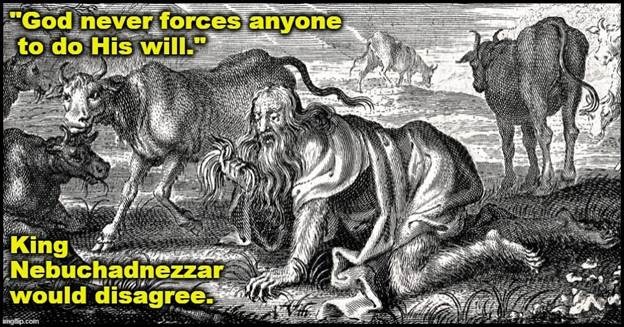 Look at this meme that has been circulating on the internet.
This meme of Nebuchadnezzar attempts to prove that God’s sovereignty and man’s free will are incompatible. Memes can be read very quickly but it takes longer to look into the background.
Let’s look at Daniel 4 to see what it says.
“Now all this happened to King Nebuchadnezzar. After twelve months, he happened to be walking around on the battlements of the royal palace of Babylon. The king uttered these words: ‘Is this not the great Babylon that I have built for a royal residence by my own mighty strength and for my majestic honor?’ While these words were still on the king’s lips, a voice came down from heaven: ‘It is hereby announced to you, King Nebuchadnezzar, that your kingdom has been removed from you! You will be driven from human society, and you will live with the wild animals. You will be fed grass like oxen, and seven periods of time will pass by for you before you understand that the Most High is ruler over human kingdoms and gives them to whomever he wishes.’ Now in that very moment this pronouncement about Nebuchadnezzar came true. He was driven from human society, he ate grass like oxen, and his body became damp with the dew of the sky, until his hair became long like an eagle’s feathers, and his nails like a bird’s claws” (Daniel 4:28-33, NET)
Nebuchadnezzar II was the king of Babylonian Empire. He reigned from 605 BC to 562 BC. Nebuchadnezzar was the son of Nabopolassar, who founded the Chaldean dynasty. He was known as a conqueror who destroyed the city of Jerusalem in 586 BC. The Hanging Gardens of Babylon, one of the wonders of the ancient world, were built during his reign.
We see his name mentioned about 90 times in the pages of the Hebrew Scriptures, mostly in the books of Daniel and Jeremiah. God calls the king “His servant” (Jer. 27:6) and the instrument of His judgement against the recalcitrant people of Judah. In the book of Daniel, Nebuchadnezzar is confronted by the power of God in the revelation of his dreams and in attempted execution of Shadrach, Meshach, and Abednego in the furnace. Daniel records that the king proclaims that Daniel’s God is King of Heaven (Dan. 4:37), even though he worshipped the Babylonian idols Marduk and Babu as well. Because of this, Nebuchadnezzar could be consider either a pluralist or a henotheist, one who believed in one supreme God over all other deities.
In Daniel 4, the incident covered by the meme in question, Nebuchadnezzar, while walking the structure of his palace, considered the city of Babylon and all that he constructed and took pride in what he had done. He believed that he had made all the great city and its defensive emplacements for his own glory and honor. The voice from heaven stops Nebuchadnezzar in his tracks to proclaim that the one true God is truly sovereign, giving human kingdoms to the one He wants.
Nebuchadnezzar received the humbling sentence of divine punishment, a mental breakdown which forced him to live like a wild animal and eating grass from the field for seven years. One can imagine the scene as depicted in the meme as his advisors look upon his predicament every day for those seven years, attempting to run the empire and keeping the king’s condition from the people and his enemies. Nebuchadnezzar awakened from his condition, repenting and realizing that God is the One who is really in charge.
Daniel continued,
“But at the end of the appointed time I, Nebuchadnezzar, looked up toward heaven, and my sanity returned to me. I extolled the Most High, and I praised and glorified the one who lives forever. For his authority is an everlasting authority, and his kingdom extends from one generation to the next. All the inhabitants of the earth are regarded as nothing. He does as he wishes with the army of heaven and with those who inhabit the earth. No one slaps his hand and says to him, ‘What have you done?’ At that time my sanity returned to me. I was restored to the honor of my kingdom, and my splendor returned to me. My ministers and my nobles were seeking me out, and I was reinstated over my kingdom. I became even greater than before. Now I, Nebuchadnezzar, praise and exalt and glorify the King of heaven, for all his deeds are right and his ways are just. He is able to bring down those who live in pride” (Daniel 4:34-37, NET).
Nebuchadnezzar learned, in his own words, that his pride went before his fall. What happened in this account is not a dispute over the king’s free will, but of his punishment because Nebuchadnezzar forgot Who had put him in power. God put the king in his place for a time to teach him about the sin of overbearing pride, into which Nebuchadnezzar went of his own free will.
Jesus said that pride comes from the human heart and makes a person unclean and sinful (Mk. 7:21-23). The meme above attempts to make a theological point against free will, but misses the point of the account of Nebuchadnezzar and his temporary insanity.
Perhaps we can learn a valuable lesson when evaluating memes on the internet,
“Instead of accepting the meme, we should look back at the whole Biblical scene.”
 Mark Riser - Apologist