

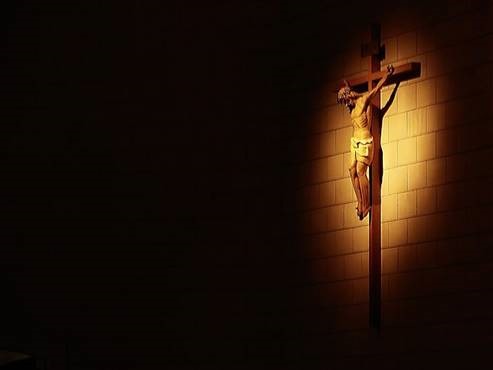
“Eloi, Eloi, lemá sabachtháni?”
On an unseasonably dark afternoon in 33 AD, Jesus of Nazareth was executed by crucifixion by the Roman authorities at the behest of the Jewish leadership, who charged Him with blasphemy. During His those hours on the cross, Jesus made several statements. One of those statements, quoted above and recorded in two of the gospel accounts, was “Eloi, Eloi, lemá sabachtháni?”
A Jewish person who observed that tragic scene should have recognized that quotation. It was the first line of the twenty-second Psalm, attributed to King David. As He quoted that first line, Jesus was taking that Psalm for Himself and declaring that He was the fulfillment of that great song of the Jewish faith.
That statement has been characterized as a “Cry of Dereliction.”
Christians now look at the Psalm of David as Messianic in nature and a note of triumph.
There are two distinct divisions of Psalm 22
In verses 1-18, the writer of Psalm 22 speaks of his suffering. He was,
· Surrounded by enemies (v. 12-13)
· Mocked by enemies (v. 6-8)
· Suffered physical trauma (v. 14-15, 17)
· Pierced in his hands and feet (v. 16)
· Stripped of his clothes, which were divided among the enemies (v. 18)
It must be pointed out that none of those distressing events ever happened to David. We have no recorded incidents in the life of David where he experienced such total calamity.
But, experiences of this nature were recorded as taking place in the final hours of Jesus’s earthly life. Those experience may not have happened to David, but they were inflicted on Jesus. It is intriguing to note, as scientist and apologist Dr. Hugh Ross noted in a recent article, that those who execute the subject of the Psalm are Gentiles. The use of the term “dogs” in verse 16 was a derogatory word for those who were not Jews.
The descriptions of intense physical suffering and bodily injury to the hands and feet comport very well with someone who was executed by crucifixion, a process for execution that may have not been familiar to David, but was devised by the Persians, introduced to the area by Alexander the Great, and perfected into a cruel method of death by the Romans.
The victim in Psalm 22 was at the lowest point in his life and facing the end, hence the cry of verse 1. But, there is a remarkable change beginning in verse 19.
In verses 19 and following, the victim has placed his faith for deliverance in God. The writer, who had a few verses before was experiencing dereliction, despair, and death, became a victor.
The victim prayed for God to come and help him. He asked for deliverance from the “dogs.” In verse 24, he knows that God has not left him.
“For He has not despised or detested the torment of the afflicted. He did not hide His face from him but listened when he cried to Him for help” (Psalm 22:24, HCSB).
At the end of the song, the erstwhile victim became a herald for God. The result of the victim’s work would be that the world would come to know the Lord, even the Gentiles, or “dogs,” that tormented him. Even future people would learn of the righteousness of God.
It is not difficult to see why Jesus would claim this particular psalm as His.
The things that did not happen to David as he wrote this song happened to Jesus about one thousand years later. The response of the centurion that Jesus was surely the Son of God (Mt. 27:54, Mk. 15:39, Lk. 23:47) is the same as believers have made ever since, that Jesus is indeed the Son of God and the fulfillment of Psalm 22.
Instead of a “cry of dereliction,” the call of Psalm 22 became a note of triumph.
 Mark Riser - Apologist